
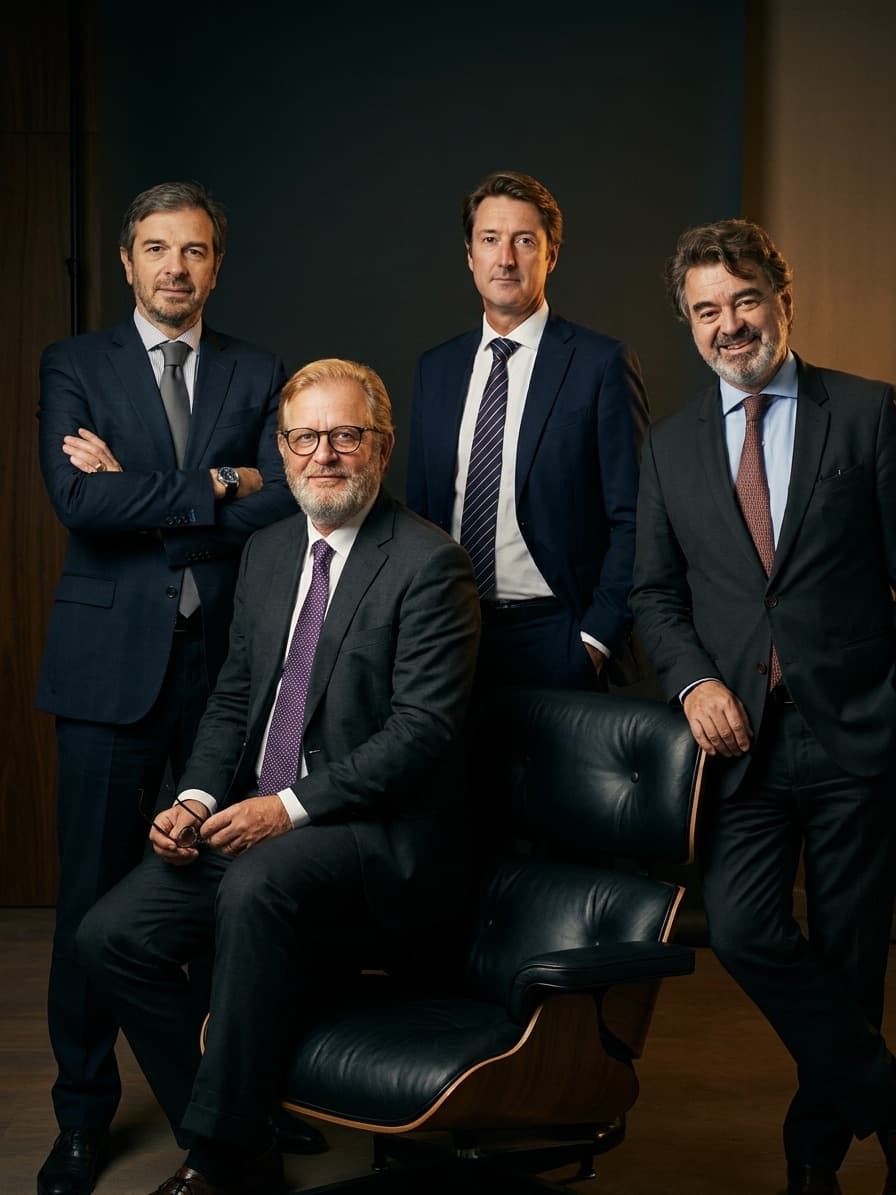
From two independent firms to a leader in private wealth management.
Tiepolo was born in January 2022 from the merger of two entrepreneurial asset management firms: J. de Demandolx Gestion, founded in 1989, and Financière Tiepolo, founded in 2007. Two firms that shared the same conviction — independence, non-intermediated management, tailored relationships — and that, by merging, became one of France's leading independent discretionary wealth managers, with more than €2 billion under management.
But merging two firms also means merging two ways of tracking a client: two histories of record-keeping formats (handwritten and digital), two regulatory document nomenclatures, and managers with 10 to 40 years of experience, each with their own method. Tiepolo's business — discretionary management (70% in direct securities), wealth engineering, multi-management, retirement and employee savings, with 5 custodians and 10 insurance partners — rests on one promise: knowing every family better than anyone, over the long run. And on a rare model, since its 12 private wealth managers handle both portfolio management and business development.
That promise cannot rest on a generic CRM.
The challenge: capturing the full complexity of a family's wealth.
A Tiepolo client isn't a row in a spreadsheet. It's an individual or legal entity nested inside a tax household, itself nested inside a family group: three levels that no CRM on the market natively supports. It's financial wealth spread across securities accounts, PEAs, PERs, life insurance, and fund-of-funds vehicles; real estate and professional assets held in full ownership, usufruct, or bare ownership; debts tied to specific assets; and flows feeding into the wealth summary. And on top of that, the full regulatory apparatus of an AMF-licensed management firm (KYC, AML/CFT), each with its own validity date and review status.
Before Standards, all this information lived scattered across an aging portfolio management system, paper files, and scanned documents inherited from the two founding firms, buried inside a disconnected document management system. Finding out who owns what, with whom, and since when, meant cross-checking multiple sources and took time.
« A private wealth manager's job is to grow a client's wealth — not to do archaeology across data sources. »
One single source of truth for every client, every household, every asset.
With Standards — which Tiepolo renamed Daphné internally — the firm took full ownership of a new agentic technology: a data graph where every contact and every entity is linked to its assets, debts, flows, and regulatory documents. Where a classic CRM stops at a contact card, Standards relies on a differentiating building block: qualified relationships ("I own this company," "I hold usufruct on this property") where the role, the share, and the ownership regime live on the relationship itself rather than on the person's record — making it possible to represent every tax household as a visual org chart.
Building this foundation first required deep groundwork. The migration itself was carried out by the AI: roughly 440,000 files converted, about 100GB of PDFs mapped into Daphné. In parallel, systematic deduplication of contacts, companies, and tax households inherited from the two original firms — with human validation on complex cases — delivered a clean, complete, and powerful base.
To digitize handwritten wealth summaries, KYC, and AML/CFT forms, Tiepolo built a family of agents dedicated to extracting and mapping them, with strict rules on each agent's scope. An agent processing a KYC form with less detailed wealth data than a wealth summary doesn't overwrite the existing data — it completes it, and brings a human into the loop whenever necessary. The person who steps in can answer a set of questions directly, or assign the open questions to a colleague.
This shared conversation between humans and agents, and routing open questions at the right moment, makes data sourced from many places reliable.
The agents can do everything with documents:
- Extract data and fill in fields across every Standards database.
- Attach the file it just read to the client's drive space, in the right folder.
- Split, merge, and rearrange pages.
- Generate new documents from the extracted data: letters, summaries, pre-filled forms, recap PDFs.
- Check the consistency and compliance of the information before saving anything, pausing to ask for human validation whenever a data point is ambiguous, missing, or sensitive (IBAN, amount, identity).
- Automatically reconcile multiple sources (statements, instructions, supporting documents) to flag discrepancies or missing transactions.
- Log every action taken to keep a complete audit trail, ready for any inspection or audit.

What used to be tedious manual entry, often pushed back to the end of the week, is now a visual check that takes a few minutes.
Compliance, the heart of the engine.
Building agents isn't an end in itself: they still need to help a management firm stay compliant. The agents keep updating the data that feeds regulatory-deadline dashboards at several levels: the entire client base (for management), a tax household, and an individual.
Renewal deadlines for KYC, AML/CFT, ID documents, and proof of address are recalculated automatically from each document's signature and validity dates, without a single team member having to re-enter a date.
On a tax household's file, the Compliance tab aggregates the status of all four declarants at a glance: a red "Urgent" banner immediately flags that 2 of 4 members aren't compliant, with a named breakdown of what's missing for each. No need to open four separate contact files to spot the gap — the household view does the synthesis for the manager.




The same applies one level down, on each individual's file. And the same logic rolls back up to the entire client base, for management and the compliance officer function.
Tiepolo's path looks like that of many entrepreneurial management firms: growth, first organic then through merger, made the wealth of information grow far faster than the tools meant to carry it. The answer wasn't to bolt on yet another piece of software, but to consolidate all the data into a single system, make that foundation reliable before automating anything, build narrow, verifiable agents rather than one generalist AI asked to do everything, and keep humans as the decision-makers on anything touching money, identity, or compliance.
The result isn't a technology gadget: it's time given back to private wealth managers, time they can spend on what Tiepolo has existed for since 1989 — calm, independent, tailored management. And an infrastructure built to double its assets under management.